MAST: Barbara A. Mikulski Archive for Space Telescopes
Map of the Universe from Johns Hopkins University and others.....
Johns Hopkins University (JHU) continues to pad its space community résumé with their interactive map, “The map of the observable Universe”,
 that takes viewers on a 13.7-billion-year-old tour of the cosmos from the present to the moments after the Big Bang.
 While JHU is responsible for creating the site, additional contributions were made by NASA, the European Space Agency,
 the National Science Foundation, and the Sloan Foundation.
JWST's weekly observing schedule:
NASA's Unverse of Learning
An Integrated AstroPhisics STEM Learning and Literacy program
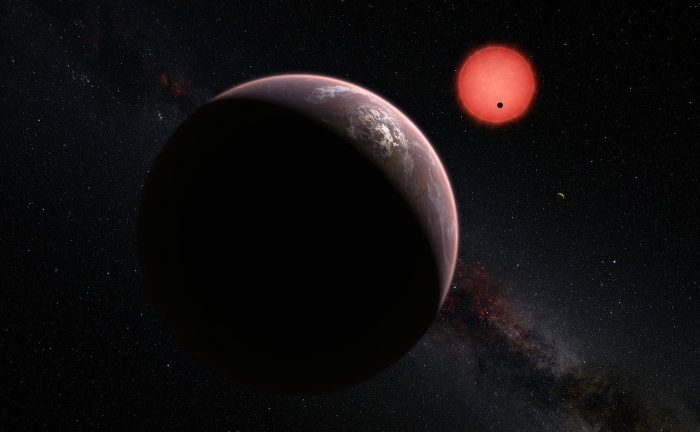
Artist's impressions of three newly-discovered exoplanets orbiting an ultracool dwarf star TRAPPIST-1.

 Credit: ESO/M. Kornmesser/N. Risinger (skysurvey.org).
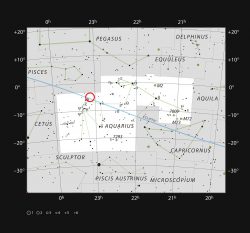
Location of TRAPPIST-1 in the constellation Aquarius. Credit: ESO/IAU and Sky & Telescope.
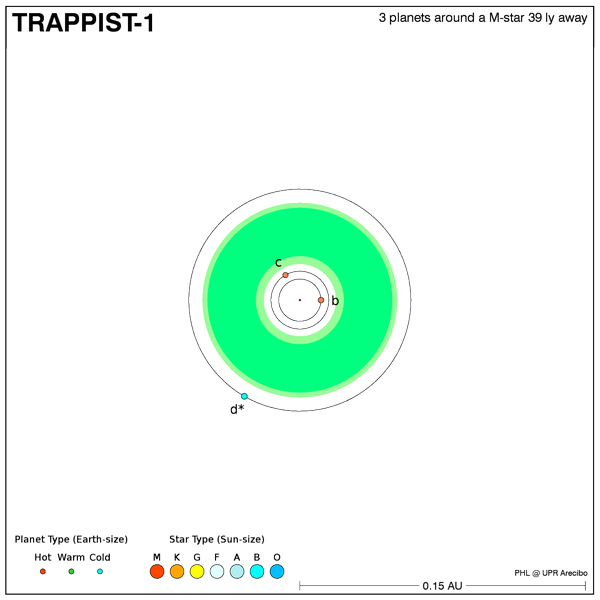
Structure of the TRAPPIST-1 exosystem. The green is the star’s habitable zone. Credit: PHL.
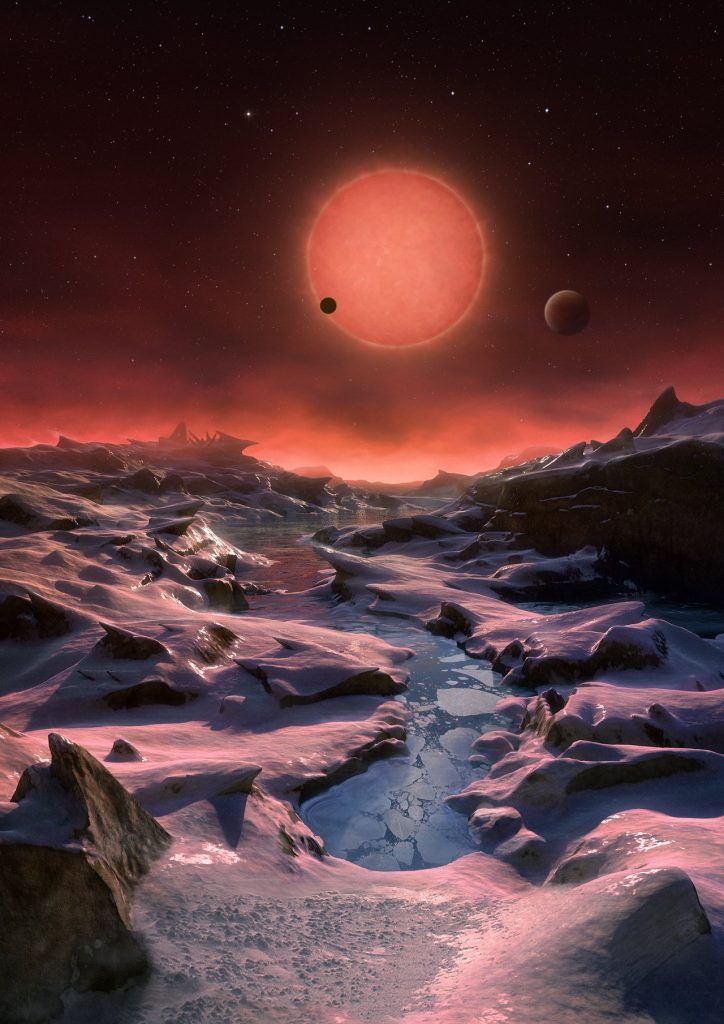
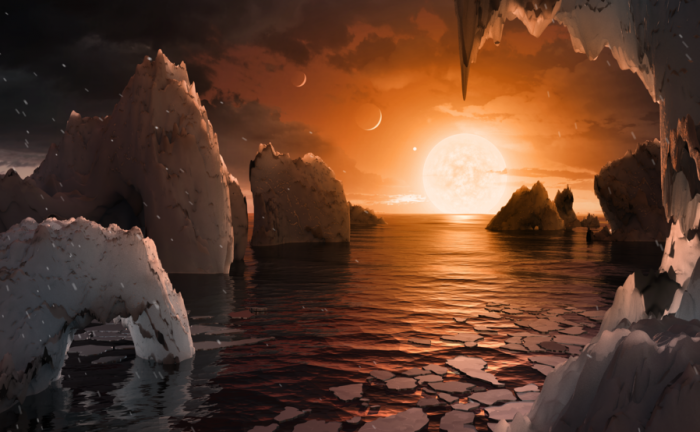
Artist’s impression of the view from the most distant exoplanet discovered around the dwarf star TRAPPIST-1.

 Credit: ESO/M. Kornmesser.
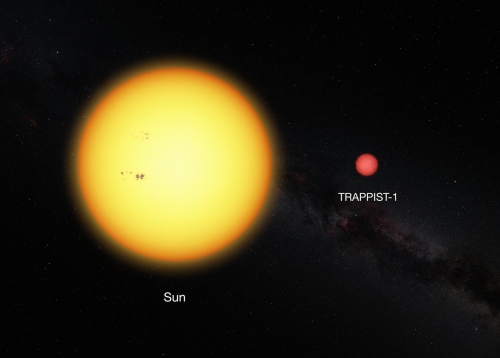
Image: Comparison between the Sun and the ultracool dwarf star TRAPPIST-1. Credit: ESO.

That’s a useful insight because we have no other information about the nature of these planets.

 Their masses have not been measured, and we have no other data about the kind of planets that can exist

 around ultracool dwarf stars (TRAPPIST-1 is an M8 dwarf) because the TRAPPIST-1 worlds are our first transiting example.

The excerpt below shows the team’s reasoning, building on the fact that the lack of features in the combined spectrum

rules out certain kinds of atmospheres:
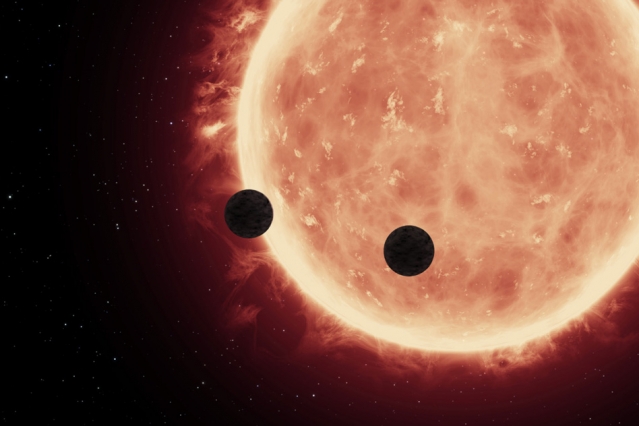
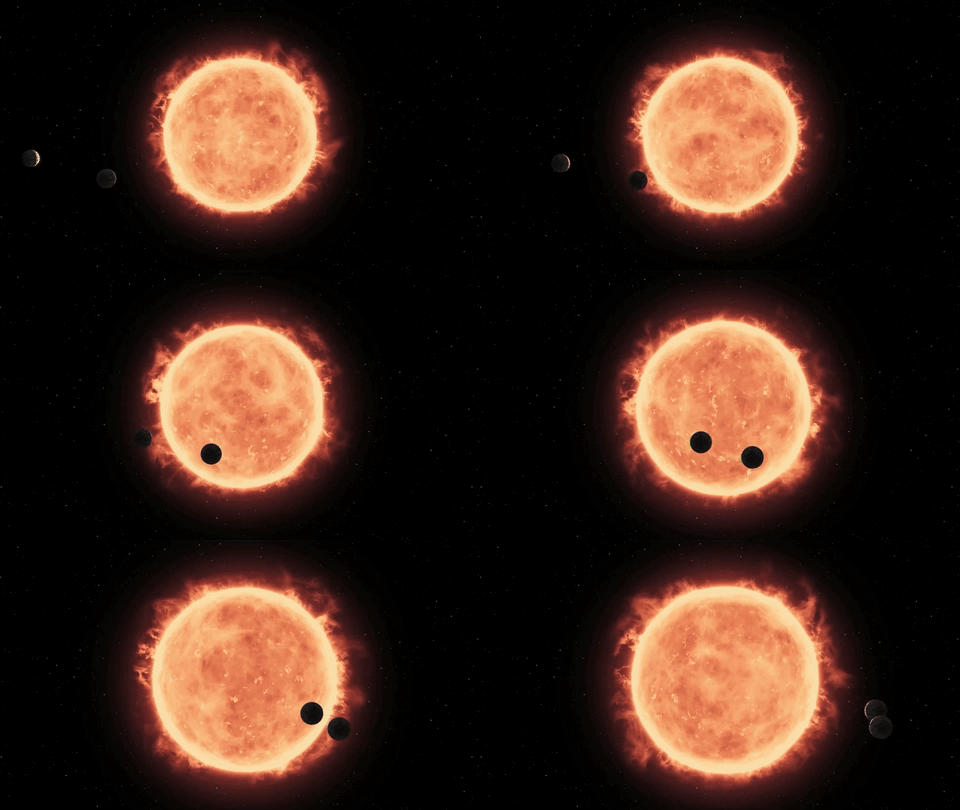
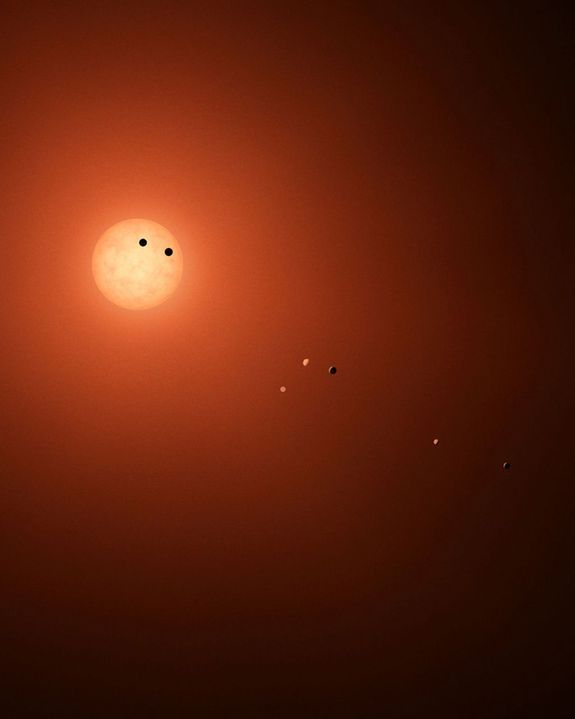
Image: The binary transit visualized. Credit: NASA/ESA/STScl.
With an extended gas envelope ruled out, we wind up with a range of possible atmospheres,

ranging from the CO2-dominated Venus to an Earth-like atmosphere with heavy clouds or a depleted atmosphere

like what we see on Mars. To push further into the possibilities, the team has formed a consortium called

SPECULOOS (Search for habitable Planets Eclipsing ULtra-cOOl Stars), the good news being that they are building

larger versions of the TRAPPIST instrument in Chile that will focus on the brightest ultracool dwarf stars in the southern hemisphere.

 Consider the effort an attempt to build the kind of pre-screening tools that our future space telescopes like the

 James Webb instrument will need for their target list.
The paper is de Wit et al., “A combined transmission spectrum of the Earth-sized exoplanets TRAPPIST-1 b and c,” Nature 20 July 2016 (preprint).

 The discovery paper is Gillon et al., “Temperate Earth-sized Planets Transiting a Nearby Ultracool Dwarf Star,”

 published online in Nature 2 May 2016 (abstract). An MIT news release is available
HUGE NEWS, SEVEN EARTH-SIZED WORLDS ORBITING A RED DWARF, THREE IN THE HABITABLE ZONE
Seven New Earth Sized Worlds Discovered?
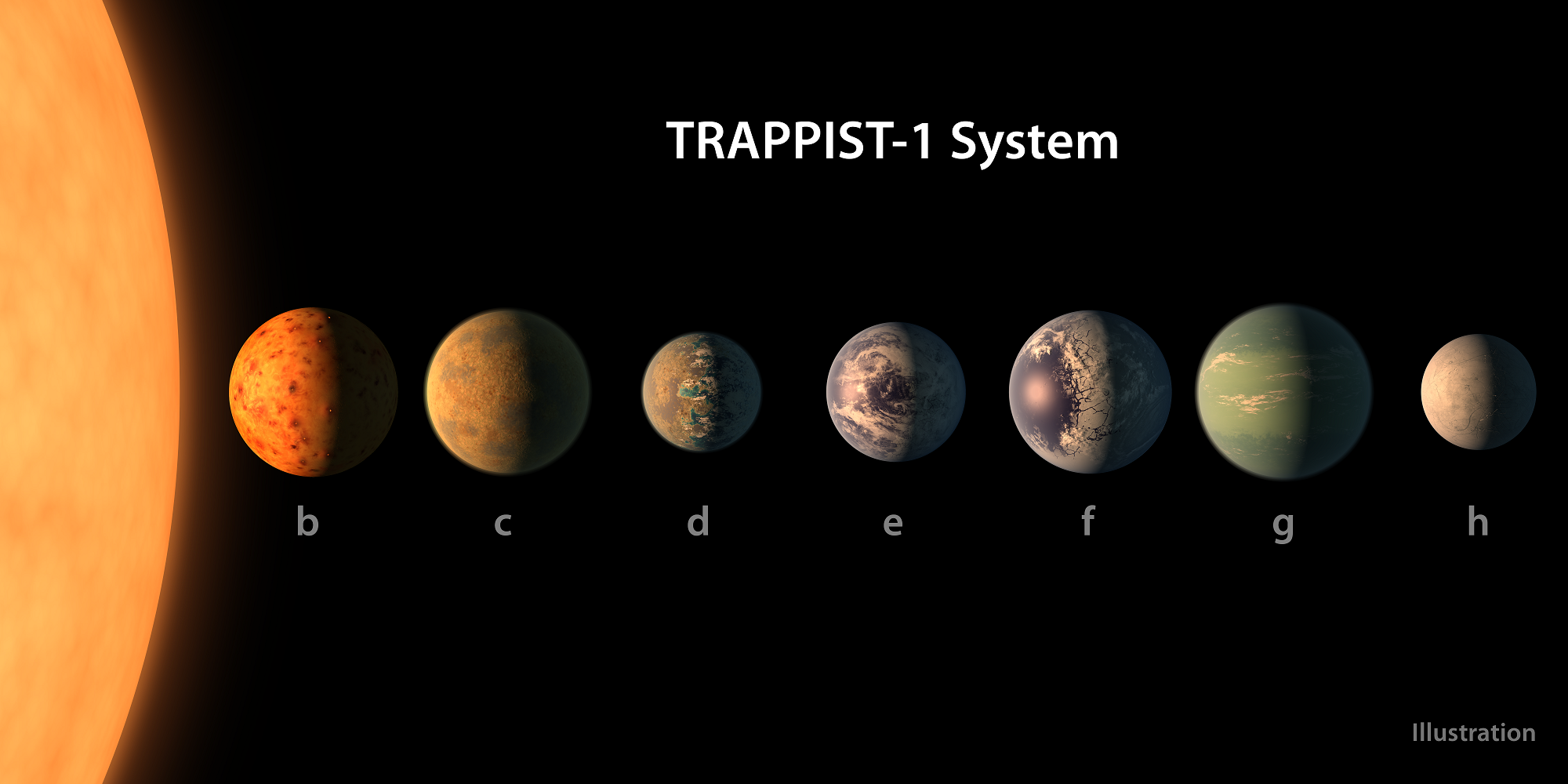
Artist’s concept showing what each of the TRAPPIST-1 planets may look like, based on available data about their sizes,
 masses and orbital distances.
 Credits: NASA/JPL-Caltech
NASA & TRAPPIST-1: A Treasure Trove of Planets Found
Published on Feb 22, 2017
Seven Earth-sized planets have been observed by NASA's Spitzer Space Telescope around a tiny, nearby, ultra-cool dwarf star called TRAPPIST-1.
Three of these planets are firmly in the habitable zone.
Over 21 days, NASA's Spitzer Space Telescope measured the drop in light as each planet passed in front of the star.
Spitzer was able to identify a total of seven rocky worlds, including three in the habitable zone, where liquid water might be found.
The video features interviews with Sean Carey, manager of the Spitzer Science Center, Caltech/IPAC; Nikole Lewis,
James Webb Space Telescope project scientist, Space Telescope Science Institute; and Michaël Gillon, principal investigator,
TRAPPIST, University of Liege, Belgium.
The system has been revealed through observations from NASA's Spitzer Space Telescope and the ground-based
TRAPPIST (TRAnsiting Planets and PlanetesImals Small Telescope) telescope, as well as other ground-based observatories.
The system was named for the TRAPPIST telescope.
NASA's Jet Propulsion Laboratory, Pasadena, California, manages the Spitzer Space Telescope mission for NASA's Science Mission Directorate,
Washington. Science operations are conducted at the Spitzer Science Center at Caltech in Pasadena.
Spacecraft operations are based at Lockheed Martin Space Systems Company, Littleton, Colorado.
Data are archived at the Infrared Science Archive housed at Caltech/IPAC. Caltech manages JPL for NASA.
For more information about Spitzer,
NASA SPITZERCALTECH SPITZER
Image Credit:
NASA/JPL-Caltech
Category
Science & Technology
License
Standard YouTube License
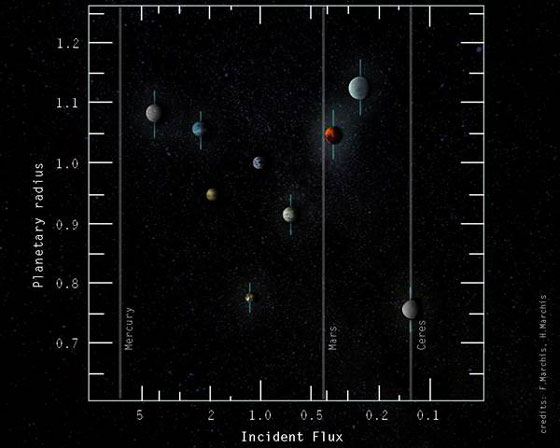
A plot of diameter versus the amount of sunlight hitting the planets in the TRAPPIST-1 system,
scaled by the size of the Earth and the amount of sunlight hitting the Earth.
Credit: F. Marchis/H. Marchis
Finally Released: The James Webb Telescope Image of TRAPPIST-1 We've all been Waiting For
 #jameswebbtelescope #jwst #jameswebbspacetelescope
#jameswebbtelescope #jwst #jameswebbspacetelescope
Finally Released: The James Webb Telescope Image of TRAPPIST-1 We've all been Waiting For

There are few questions of more profound importance when it comes to our place in the universe.
 But while most people believe alien life is out there, it's a lot harder to pinpoint exactly where.
At least, that was the case until we started looking at the TRAPPIST-1 star system. In the hunt for
alien life, there are few better candidates. We know that Earth-like planets are fertile ground for life;
after all, life arose here. So, to find a planetary system that is seemingly full of Earth-like planets,
and is relatively close by at just 40 light-years away, it's no wonder that scientists are so interested.
Those researchers have now turned humanity's most powerful space telescope, the James Webb Space Telescope,
 on the TRAPPIST-1 system. For years, the biggest question has been: do any of these planets have atmospheres? Now, the first data is in, and it's time to find out the truth. The results are not what we expected. Some hopes have been challenged, while entirely new, stranger possibilities are emerging.


 For business inquiries, copyright matters or other inquiries please contact us at:•

⚠️ Copyright Disclaimers
• We use images and content in accordance with the YouTube Fair Use copyright guidelines
• Section 107 of the U.S. Copyright Act states: “Notwithstanding the provisions of sections 106 and 106A,
the fair use of a copyrighted work, including such use by reproduction in copies or phonorecords or by any
other means specified by that section, for purposes such as criticism, comment, news reporting, teaching
(including multiple copies for classroom use), scholarship, or research, is not an infringement of copyright.”
• This video could contain certain copyrighted video clips, pictures, or photographs that were not specifically
authorized to be used by the copyright holder(s), but which we believe in good faith are protected by federal law
 and the fair use doctrine for one or more of the reasons noted above.
What James Webb Discovered on the TRAPPIST-1 System: The Verdict Is In
The James Webb Space Telescope has finally delivered its most important results yet on the TRAPPIST-1 system
and the findings are far more complex than expected.
TRAPPIST-1 is a red dwarf star located 40 light-years from Earth, hosting seven Earth-sized rocky planets.
It is one of the most promising systems ever discovered for studying potentially habitable worlds beyond our solar system.
In this documentary, we break down every planet in the TRAPPIST-1 system using the latest JWST data, including:
Planet b: a scorched, airless world
Planet c: the coldest rocky exoplanet ever measured
Planet d: a possible atmospheric mystery
Planet f: a steam-world candidate
Planet g & h: outer system unknowns
Planet e: the most Earth-like canidate ever observed
Using transmission spectroscopy, JWST is beginning to reveal what these distant worlds are made of —
and whether any of them could potentially support life.
However, the data is still incomplete. While some atmospheres appear to be absent, others remain uncertain,
and stellar activity from TRAPPIST-1 complicates all interpretations.
So what is the final verdict?
At this stage, TRAPPIST-1 is not confirmed to host life — but it remains one of the strongest candidates
in the search for habitable exoplanets.
This is the most detailed JWST analysis of TRAPPIST-1 to date.
👽 Don’t get left behind! Subscribe to the NEWSLETTER and be part of the launch crew! 🚀👇
--
DISCUSSIONS & SOCIAL MEDIA
E-mail:Commercial Purposes:Tik Tok:Reddit:Instagram:Twitter:Facebook:Linkedin:Our Website:
Credits: Ron Miller, Mark A. Garlick / MarkGarlick.com ,Elon Musk/SpaceX/ Flickr
MusicArtlist
--
:00 The Most Important Question in Space
0:55 TRAPPIST-1: The Discovery That Changed Everything
2:10 Why This System Is So Unique
3:25 The Red Dwarf Problem
4:45 Why Most Life Around Red Dwarfs Fails
6:05 How TRAPPIST-1 Was Actually Found
7:40 Transit Method Explained
9:10 The Seven Planet System Revealed
10:35 Why JWST Changed the Game
12:00 Transmission Spectroscopy Explained
13:40 Planet b — A Dead Rocky World
15:05 Planet c — The Coldest Measured Exoplanet
16:30 Planet d — The Atmospheric Mystery
18:15 Planet f — The Steam World Problem
19:40 Planet g — Outer Edge Candidate
20:55 Planet h — The Frozen Unknown World
22:10 The Missing Planet (Planet e Setup)
23:00 Planet e — The Most Important World
24:20 What JWST Actually Found
25:10 The Real Possibility of Life
25:40 What Happens Next (JWST + Future Missions)
26:00 The Verdict on TRAPPIST-1
--
#insanecuriosity #trappist1 #trappistsystem
AI-generated video summary
Quality and accuracy may vary.
Insane Curiosity examines the seven Earth-sized rocky planets orbiting the ultra-cool dwarf star TRAPPIST-1.
By detailing how the James Webb Space Telescope employs transmission spectroscopy to analyze these distant atmospheres,
the exploration investigates whether any of these worlds possess the conditions necessary to harbor life.